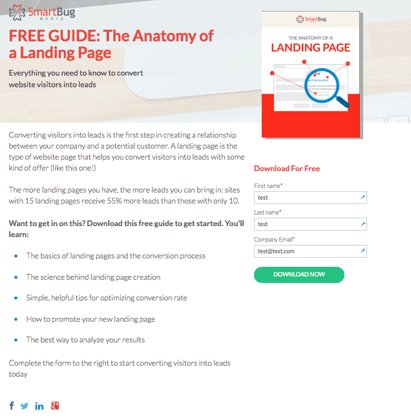
In digital marketing, a landing
page is a standalone web page, created specifically for the purposes
of a marketing or advertising campaign. It’s where a visitor “lands” when
they have clicked on a Google AdWords ad or similar.
Landing pages are designed with a single focused
objective – known as a Call to Action (CTA).This
simplicity is what makes landing pages the best option for
increasing the conversion rates of your Google AdWords campaigns.
CONVERTING
VISITORS
Converting visitors into leads is the first step in
creating a relationship between your company and a potential
customer. The more landing pages you have the better. In fact,
HubSpot conducted a recent study that showed that marketers saw a
55% increase in leads when they increased the number of landing
pages on their site from 10-15. This data alone tells us that
landing pages are important, but if you aren’t sure what this means
for your company, do not fret. Everything you need to know about
what landing pages are and how they work is right here.
What is a
Landing Page
A landing page
is a page on your site that is designed to convert visitors into
leads. A landing page is different from other pages in that it
follows both of these criteria:
It has a form
that allows you to capture a visitors information in exchange for
a desired offer
The sole purpose of the
landing page is to convert visitors into leads (ie a homepage
with a form on it does not count as a landing page because it
serves other purposes as well).
If you remember
anything from this, remember that a landing page is any page on your
website with no navigation and form used to convert visitors into
leads and every site should have them.Simply
put, a landing page is any page with no distractions that has a form
on it.
Here is an
example of what a typical landing page looks like:
How Do Landing
Pages Work?
We use money
every day to pay for goods and services. The concept of monetary
value can be applied to the logistics behind a landing page in that
you’re exchanging equally valuable information depending on which
side of the exchange you’re standing on. A visitor will fill out the
form on the landing page because they believe the content they are
accessing will be valuable to them. On the opposite side of the
coin, a marketer will gladly give the piece of content to the site
visitor because the valuable information they desire is the
information the visitor provides on the form to use in future
marketing efforts. It’s a win-win situation.
Behind the
scenes, landing pages work like this:
STEP 1: A
person sees a call-to-action and ends up on a landing page with a
form
STEP 2: The
person fills out a form which converts them from a visitor into
lead.
STEP 3: The
information from the form fields is then stored in your leads
database.
STEP 4: You
market to the contact or lead based on what you know about them
If you use a
tool like HubSpot, you’ll be able to see what offer the lead
converted on, when they converted, and other interactions they’ve
had on your site. This information will allow you to nurture this
lead in a more targeted way by helping you decide which marketing
actions are most appropriate to take. A nurtured lead is more
likely to become a marketing qualified lead (MQL), and move through
the marketing funnel faster. This helps show the ROI of your
marketing efforts and keeps your sales team happy.